
Which are the best AI visibility tools for your team in 2026?
The best AI visibility tools answer different buying needs. Ahrefs Brand Radar lets you research an existing answer index, OtterlyAI offers daily tracking on a small plan and Profound sells enterprise monitoring. Choose Atyla when a team needs the buyer question, cited URL, page correction and follow-up audit in the same workflow.
Tristan Berguer
Founder, Atyla
What do generative engine optimization tools charge for?
Vendor prices below were checked on November 24, 2026. Each price keeps its published currency and billing basis. A domain license, an answer index and a subscription for tracked questions buy different coverage. Price the actual countries, questions, engines and schedule your team intends to use before comparing quotes.
| Tool | What to inspect in a demo | Price and vendor source |
|---|---|---|
| Atyla | Page-level SEO and GEO fixes checked on the next audit | €89/month excl. VAT, Starter |
| Ahrefs Brand Radar | Search an existing index for brand and product mentions | US$199/month for one index |
| AthenaHQ | Source analysis and content actions with usage credits | US$295/month, Starter |
| GetMint | Market-level monitoring with an assigned support team | Custom quote by scope |
| Meteoria | Tag questions by audience and inspect cited sources | €75/month, Starter |
| OtterlyAI | Daily monitoring of brand mentions and citation sources | €29/month, Lite |
| Peec AI | Compare answers to a fixed set of questions across models | US$95/month, brand Starter (50 questions). One project, one country per project, multiple languages available |
| Profound | Enterprise answer analytics and reusable marketing agents | Enterprise, custom quote |
| Qwairy | Credit-based tracking with a content studio | €790 billed annually, entry brand plan |
| Rankscale | Multi-brand, multi-country tracking on credits | €99/month before promotions |
| Scrunch | Benchmark a brand and monitor its citations | US$250/month, Core |
| Semrush AI Visibility Toolkit | Research topics and track selected questions | US$99/month per domain, billed annually in the displayed plan |
| Writesonic | Track AI answers alongside a content production workflow | US$79/month billed annually, Starter |
Which AI visibility tools fit research, recurring reporting or content operations?
Use an indexed research product when your first task is finding unknown brand mentions. Use recurring tracking when you already know the buying questions and need dated answers. For content operations, ask who receives the source URL, who owns the edit and how the platform shows that the live page changed.
For an agency, Peec AI publishes a separate credit-based price list. For an enterprise buyer, Profound offers custom regions and marketing agents. For a team already buying domain-level competitive intelligence, Semrush offers an AI module. Ask all three to demonstrate your market and export a record that someone outside the platform can read.
What should you ask an AI visibility vendor to demonstrate?
Bring a buying question with a verifiable constraint, such as which warehouse label printers work offline. Ask to see the original response, open the citation and identify the relevant product version. Then ask the vendor to carry that example through a correction and a later check on the same engine.
- Define the reporting market, engine list and frequency in writing. Price a second market separately if you intend to expand.
- Check what the system records when the brand is mentioned but only a reseller gets a link. Ask how it handles missing answers.
- Export the question, answer date, source and destination page. Hand the export to the person responsible for the product listing and see whether they can act on it.
When is Atyla worth including on the shortlist?
Include Atyla if your team owns the website and can act on page-level findings. It follows customer questions in French and English, audits pages for SEO and GEO and checks changes on the next audit. The Monday report connects the work back to the answers a marketing or editorial team needs to review.
Atyla publishes this guide. Starter costs €89 per month excluding VAT. Growth costs €199 and includes the MCP server plus Claude, Mistral and Grok alongside ChatGPT, Gemini and Perplexity. Custom begins at €499. The seven-day trial lets buyers inspect a question and trace a source before choosing a subscription.
For a procurement team with enterprise identity requirements, request Profound’s scoped proposal. If research across a prebuilt answer index is the main requirement, price the relevant Ahrefs index. Ask about billing currency and annual commitments before placing either figure next to a monthly tracking plan.
What do the thirteen rows in the comparison cover?
Each row identifies the intended team, entry price, engines and vendor source. Read the price with its currency and billing commitment. A per-domain subscription and a credit pack can carry similar prices yet cover very different numbers of questions once markets, engines and collection frequency are included.
| Tool | Best for | Entry price | Engines at entry level | Source |
|---|---|---|---|---|
| Atyla | Small teams and agencies | €89/mo excl. VAT (30 questions) | ChatGPT, Perplexity, Gemini (6 on Growth) | Pricing |
| Profound | Enterprises | Enterprise, custom quote | Up to 10 on Enterprise | Pricing |
| Peec AI | Teams comparing answers across models | US$95/month, brand Starter (50 questions). One project, one country per project, multiple languages available | 3 engines of your choice among 8 (ChatGPT, Perplexity, AI Overviews, AI Mode, Gemini…) | Pricing |
| Otterly.AI | Starting small | €29/month, Lite | ChatGPT, AI Overviews, Perplexity, Copilot, AI Mode, Gemini, Claude (credit-based) | Pricing |
| Semrush (AI Visibility Toolkit) | SEO teams already on Semrush | US$99/month per domain, billed annually in the displayed plan | Mention reports cover ChatGPT, Google AI, Gemini and Perplexity. Verify the engines available for your own questions. | Pricing |
| Ahrefs Brand Radar | Market research and SEO teams | US$199/month for one index | Google AI Overviews, Google AI Mode, ChatGPT, Gemini, Perplexity, Copilot | Pricing |
| Scrunch | Enterprises, high volume | US$250/month, Core | ChatGPT, Perplexity, Gemini, AI Overviews, AI Mode, Copilot, Grok, Meta AI | Pricing |
| AthenaHQ | Tracking 11 models on Starter | US$295/month, Starter | 11 on Starter (incl. Claude, Grok, Mistral, Meta AI) | Pricing |
| Writesonic | Tracking and writing in one tool | US$79/month billed annually, Starter | ChatGPT, Gemini, Google AI Overviews | Pricing |
| Rankscale | Small budget, many engines | €99/month before promotions | Rankscale lists 17 or more engines on each plan, including app interfaces and API models | Pricing |
| Qwairy | Many engines and countries, priced in euros | €790 billed annually, entry brand plan | Engines marked UI on every plan. API models are available on request. | Pricing |
| Meteoria | Sentiment tracking | €75/month, Starter | Depends on the configuration (ChatGPT, Perplexity, Gemini, Claude, Google AI Overviews at least) | Pricing |
| Getmint | Tracking plus content production | Custom quote by scope | 3 AI models on Advanced; the site names ChatGPT, Gemini, Perplexity, Claude, AI Overviews | Pricing |
How to read this table
Volumes don’t compare one to one: a “question”, a “query” and a “credit” mean different things at different vendors, and some prices assume annual billing. More importantly, the same price doesn’t buy the same measurement quality. AI answers vary from run to run, and a number without the answer count or a margin of error doesn’t tell you much.
When does Atyla fit and what should a trial demonstrate?
Atyla suits a team responsible for tracing a wrong answer, revising the relevant page and checking publication in a subsequent audit. During the trial, open an answer, find its source and inspect the instruction attached to the URL. Confirm the collection frequency for the engines that matter in your market.
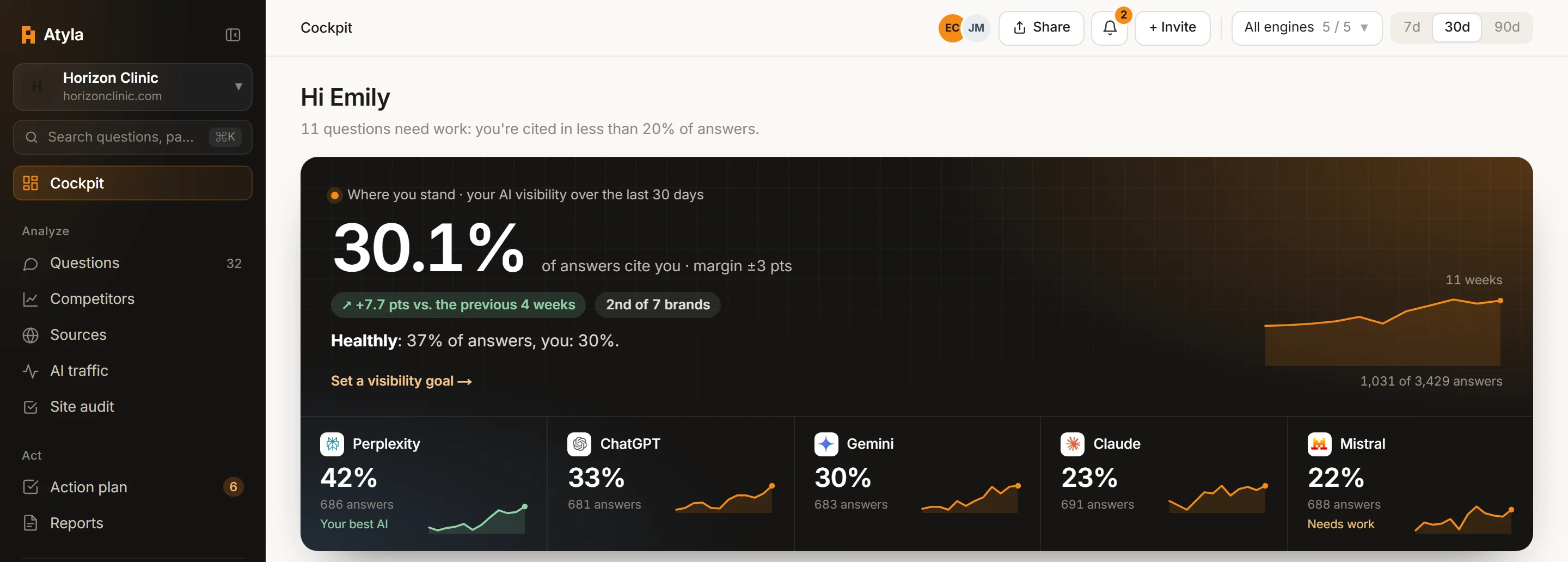
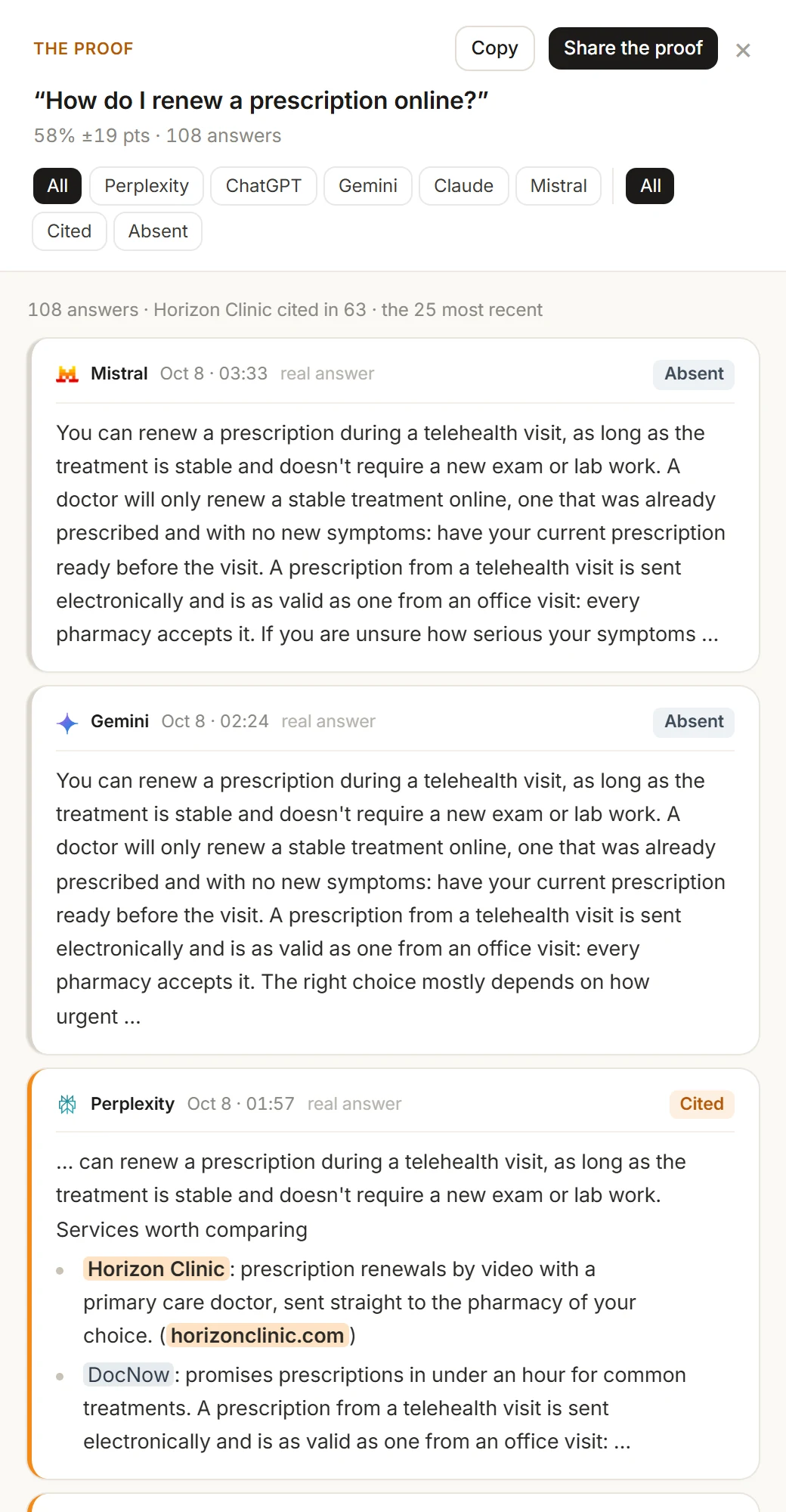
Atyla is a French AI visibility and SEO platform. Every day, it asks your customers’ questions to ChatGPT, Perplexity and Gemini, plus Claude, Mistral and Grok every 3 days on the Growth plan. It shows the share of answers that mention your brand, with its margin of error, who gets mentioned instead of you, and which sources the AI reads. Every number opens onto the real, timestamped answers: you read exactly what the AI said, and when.
What Atyla does
- Measurement with a margin of error: every rate comes with its 95% confidence interval. A rise or drop is only reported when it falls outside the margin.
- Proof from real answers: competitors mentioned, sources the AI reads, and the answers themselves, highlighted.
- Your SEO data: connects with Search Console, Google Analytics 4 and Bing Webmaster Tools.
- Audit and action plan: a weekly site audit checked page by page, a prioritized plan (“My week”), page drafts and writer briefs.
- Measured impact: visibility before and after every action. When the change stays within the margin, Atyla says so instead of claiming a win.
- An agent that fixes your site: an MCP server so Claude Code, Codex or Cursor can apply fixes, plus a REST API (Growth plan).
- Reports and alerts: a Monday report and email alerts; Slack, Discord, Zapier or webhook alerts and a monthly leadership report on Growth.
- AI crawlers: connect Senthor, our partner, to see which AI bots read your site.
What Atyla doesn’t do (yet)
- • No sentiment analysis: Atyla measures whether you’re mentioned, not the tone
- • No multi-country tracking for a single brand: each brand is tracked in one country and one language
- • 6 engines at most: Copilot, Meta AI and Google AI Mode aren’t tracked
- • Lower volumes than some competitors: 30 questions on Starter, 60 on Growth
- • No “search volume” for questions: Atyla counts the answers actually collected
- • Most engines are queried through their API, which can answer differently from the consumer app (Gemini is read from the app), as explained on our methodology page
- • The app interface is in French today
| Plan | Price (excl. VAT) | Questions tracked daily | Engines |
|---|---|---|---|
| Starter | €89/mo (or €890/yr) | 30 | 3: ChatGPT, Perplexity, Gemini, plus Google’s AI answer (AI Overviews) weekly |
| Growth | €199/mo (or €1,990/yr) | 60 | 6: adds Claude, Mistral and Grok, every 3 days |
| Custom | From €499/mo, on quote | 150+ | All engines Atyla supports |
7-day trial: card required to start the trial, nothing charged before day 8, cancel in one click. Unlimited users.
To connect AI visibility with SEO, see our guide on Search Console and AI search.
When should an SEO team choose an AI module within its existing suite?
An add-on suits a team already researching keywords and topics by domain. A dedicated tool deserves a trial when the main task involves a defined customer question list and its answers. Price the extra modules and domains required for the actual workload before comparing the total with a standalone subscription.
| Type | Examples | Entry price | Pick it if |
|---|---|---|---|
| SEO suite | Semrush AI Visibility Toolkit, Ahrefs Brand Radar | US$99/month per domain billed annually (Semrush), US$199/month per index (Ahrefs) | your team already works in the suite and wants keywords, links and AI visibility in one place |
| Writing and tracking | Writesonic, Getmint | from $79/month billed yearly (Writesonic); Getmint not published | you want to produce content in the same tool as the tracking |
| Dedicated tool | Atyla, Otterly.AI, Qwairy, Rankscale | €29 to €99/month | you mainly want to measure and fix what AI says, with a choice of engines and collection frequency |
The two families work together: the suite for keywords and links, the dedicated tool for AI answers. Atyla connects its measurement to Search Console, Google Analytics 4 and Bing, which ties AI visibility to SEO without changing suite.
Which strengths and limits matter in each vendor profile?
The profiles detail published scope, sources, billing units and questions to resolve during a demonstration. Start with your strictest requirement, such as brand-level exports or tracking across two markets. Verify it with each provider before comparing feature lists, since the entry plan may have a different scope from the platform.
Profound
Best for: Enterprises · Entry price: Enterprise, custom quote
A very complete platform built for large marketing teams: answer tracking across many engines, AI crawler analytics and content agents. Its pricing page now lists only an Enterprise plan.
Strengths
- • Up to 10 answer engines: ChatGPT, Perplexity, Google AI Mode, Gemini, DeepSeek, Claude, Google AI Overviews, Exa Search, Muse Spark, Qwen
- • Questions tracked daily
- • Agent Analytics (AI crawler visits), agents and content tooling
Worth checking
- • No public price: the page says “Custom” and offers a demo
- • No free trial mentioned on the pricing page when we checked
- • Profound describes its question volumes as estimates
Source: www.tryprofound.com/pricing, pricing and engines checked November 24, 2026.
Peec AI
Best for: Teams comparing answers across models · Entry price: US$95/month, brand Starter (50 questions). One project, one country per project, multiple languages available
A visibility tracking tool for SEO and content teams, with fine-grained tracking by country, language and persona. Starter covers one country per project. The pricing page lists Pro $245/mo (150 questions), Advanced $495/mo (350 questions).
Strengths
- • Tracking by country, language, persona and sub-brand
- • Brand perception score and checks of what AI claims
- • Robot access audit: which AI crawlers your robots.txt allows or blocks, across 40+ crawlers
- • 15% discount on annual billing
Worth checking
- • Only 3 active engines on Starter, Pro and Advanced
- • Confirm the currency and discount at checkout
- • A free trial exists, its length is not stated
Source: peec.ai/pricing, pricing and engines checked November 24, 2026.
Otterly.AI
Best for: Starting small · Entry price: €29/month, Lite
Lite includes 2,000 monthly credits. Capacity depends on the engines you select. Tracking one daily question for 31 days on four single-credit engines requires 124 credits, enough for 16 questions on this panel. Each Claude answer counts as three credits.
Strengths
- • Daily tracking on every plan
- • API, MCP and agent analytics from Standard
- • 7-day trial without a credit card
Worth checking
- • Extra credit packs are unavailable on Lite
- • The page says “4 of 7 engines” on each plan and also “every plan can track every engine”: ask which applies
Source: otterly.ai/pricing, pricing and engines checked November 24, 2026.
Semrush (AI Visibility Toolkit)
Best for: SEO teams already on Semrush · Entry price: US$99/month per domain, billed annually in the displayed plan
Base includes one Brand Performance domain and daily tracking of 25 custom questions. Your tracked questions and the wider domain mention database are different reports. The knowledge base specifies the cost of extra domains and bundles of 50 additional questions.
Strengths
- • Everything in one place: keywords, backlinks, site audit and AI visibility
- • Question Research and AI checks in Site Audit
Worth checking
- • No free trial for the AI Visibility Toolkit
- • Modest question volume at the entry tier
- • Each extra user license costs another $99/mo
Source: www.semrush.com/pricing/ai/, pricing and engines checked November 24, 2026.
Ahrefs Brand Radar
Best for: Market research and SEO teams · Entry price: US$199/month for one index
Brand Radar lets a researcher find a brand or competitor across an answer index. A custom question check allowance is included from Lite and with the all-platform Brand Radar plan. Calculate the checks required from the markets, models and frequency you intend to monitor.
Strengths
- • Huge existing question database, great for market research
- • Find the pages and domains most frequently cited in the selected index
- • Custom checks and access to the answer indexes are separate items
Worth checking
- • Set a budget by question, engine, location and frequency. Claude uses eight checks for one custom response.
- • Check the monthly allowance for custom questions separately from the price of the answer index
Source: help.ahrefs.com/en/articles/11064852-what-is-brand-radar-and-how-to-use-it, pricing and engines checked November 24, 2026.
Scrunch
Best for: Enterprises, high volume · Entry price: US$250/month, Core
High volume from the entry tier (15,000 AI responses a month) and an agent-first angle: pages generated and optimized for AI.
Strengths
- • 8 engines on Core, Claude as an add-on on Enterprise
- • 1 brand and 5 seats on Core
- • 7-day free trial
Worth checking
- • Only 10 citation targets, 10 pages optimized and 10 pages generated a month on Core
Source: scrunch.com/pricing, pricing and engines checked November 24, 2026.
AthenaHQ
Best for: Tracking 11 models on Starter · Entry price: US$295/month, Starter
Credit-based (1 credit = 1 AI answer): 3,600 credits a month on Starter, across 11 models.
Strengths
- • Free plan with 300 credits to try it out
- • 11 engines from Starter, more on request
- • Content optimization agent, on-page and off-page actions
Worth checking
- • Credit-based pricing means estimating your volume upfront
- • API access and extra credits are paid add-ons
Source: athenahq.ai/plans, pricing and engines checked November 24, 2026.
Writesonic
Best for: Tracking and writing in one tool · Entry price: US$79/month billed annually, Starter
Originally an AI writing tool, Writesonic now combines AI visibility tracking, article generation and site audits. Basic is $199/mo (100 questions) and Growth $399/mo (200 questions), both billed annually.
Strengths
- • Content generation and site audits in the same tool
- • Terms shown at signup
- • 10 AI platforms on Enterprise, including Bing and Meta AI
Worth checking
- • Perplexity, Claude, Grok and Google AI Mode are Enterprise only
- • Listed prices assume annual billing
Source: writesonic.com/pricing, pricing and engines checked November 24, 2026.
Rankscale
Best for: Small budget, many engines · Entry price: €99/month before promotions
Credit-based: an app-engine answer costs 0.25 credit, an API model answer 1 to 4 credits. Pro gives up to 4,800 AI answers a month (€84.15/mo billed yearly).
Strengths
- • Every engine available on every plan
- • 7-day trial on Pro
- • Clear step up: Pro+ €229/mo, Growth €385/mo
Worth checking
- • Credits are harder to compare than a flat question allowance
- • The trial is on request above Pro
Source: rankscale.ai/pricing, pricing and engines checked November 24, 2026.
Qwairy
Best for: Many engines and countries, priced in euros · Entry price: €790 billed annually, entry brand plan
Qwairy includes UI engines such as Naver and ChatGPT on every plan. The list also names API models that require a tailored offer. On the annual brand grid, Growth is billed at €1,990 a year and Business at €4,490 a year.
Strengths
- • Unlimited questions, within your credits (2,500 on Starter)
- • Free plan with 120 credits, no credit card
- • ChatGPT, AI Overviews, Claude, Gemini, AI Mode, Perplexity, Copilot, Grok, Meta AI and more on every plan
Worth checking
- • Credit-based pricing to estimate
- • API-based models are enabled on request, with a tailored offer
Source: www.qwairy.co/pricing, pricing and engines checked November 24, 2026.
Meteoria
Best for: Sentiment tracking · Entry price: €75/month, Starter
Meteoria separates tracked questions from credits consumed by premium operations. Starter includes 25 questions and 25 monthly credits, while Pro includes 100 of each. Segmentation lets the reader inspect answers by product, audience or territory.
Strengths
- • Sentiment analysis (positive, neutral, negative) per question
- • Google Analytics, Matomo and Looker Studio integrations
- • Trial availability and scope are shown at signup
Worth checking
- • Check the premium operations consumed and annual commitment in the terms.
- • Engines depend on the configuration chosen, and the list may change
Source: app.meteoria.ai/terms, pricing and engines checked November 24, 2026.
Getmint
Best for: Tracking plus content production · Entry price: Custom quote by scope
Combines tracking, an AI search agent that ranks opportunities, and content production (Content Studio). The Advanced plan includes 300+ questions, 5 topics, 10 competitors, 3 countries and 10 briefs and articles. See our detailed comparison, Atyla vs Getmint.
Strengths
- • Content Studio: briefs and articles in the same tool
- • Tracks shopping engines (ChatGPT Shopping, Alexa for Shopping)
- • Unlimited users, daily refresh
Worth checking
- • No price or free trial terms published
- • 12-month commitment on Advanced
Source: www.getmint.ai/pricing, pricing and engines checked November 24, 2026.
How can you check an answer manually before paying?
Take a complete buyer question and open a fresh conversation in the target engine. Record the language, country, date and links returned. Repeat the check and retain answers without mentions as well. The exercise identifies what a tool needs to archive and gives you material for a realistic demonstration.
Questions to try:
- “What are the best [products] for [need]?”
- “[Your brand] vs [competitor]: which one should I pick?”
- “What would you recommend for [use case] in [city]?”
How should a team narrow the shortlist to two trials?
Write down the weekly deliverable and who needs to produce it. Exclude plans that cannot cover a required language or output. Run the same questions through the remaining candidates, then have the future report owner review the export and the buyer check the budget at the expected volume.
1Can I verify every number?
Open a mention rate: can you see the real, dated answers behind it? Are the answer count and margin of error shown? Is the methodology public?
2The right engines, at the right volume?
Are the assistants your customers use included in the plan, or sold as add-ons? How many questions, how often, in which countries and languages?
3Then what?
Does the tool tell you what to fix and in what order, and then measure whether the fix changed anything? Without that last step, you can’t tell what works.
How do you compare free trials and entry-level access?
Check which features are enabled, whether a card is required and when billing begins. A demonstration account can show the interface. To verify your questions and export workflow, ask to run your own collection and retain the result when the trial ends. Use the vendor’s current terms for the decision.
| Tool | Trial or free plan | Credit card |
|---|---|---|
| Atyla | 7-day trial | Required, nothing charged before day 8 |
| Scrunch | 7-day trial | Not stated |
| Rankscale | 7-day trial on Pro, on request above | Not stated |
| AthenaHQ | Free plan with 300 credits | Not stated |
| Qwairy | Free plan with 120 credits | No card |
| Writesonic | Trial subject to signup terms | Check at signup |
| Otterly.AI | 7 days | No credit card |
| Peec AI | Free trial, length not stated | Not stated |
| Meteoria | Terms shown at signup | Not stated |
| Semrush AI Visibility Toolkit | No trial | Not applicable |
| Ahrefs Brand Radar | No trial mentioned on the pages we read | Not applicable |
| Profound | No trial mentioned, demo on request | Not applicable |
| Getmint | Trial terms not published, demo on request | Not applicable |
During the trial, open a metric and read the answer behind it. Download an export and check that question, market and source links stay connected.
Which tool can show an editor what to change on the website?
An actionable record lets an editor move from question to answer to a page the team owns. Ask for a specific instruction and a way to verify it after publication. For a tool that generates content, also check who approves the draft and how the revision history can be retrieved.
- Atyla: a weekly audit checked page by page, the prioritized “My week” plan, page drafts, and for each action the visibility before and after, with its margin of error.
- AthenaHQ: a content optimization agent, on-page and off-page actions.
- Getmint: a research agent that ranks opportunities, and Content Studio for briefs and articles.
- Writesonic: article generation and site audits in the same tool.
- Scrunch: optimized pages and generated pages for AI engines, 10 of each per month on Core.
- Meteoria: content recommendations and sentiment analysis.
The question to ask during the trial: “after a fix, does the tool show me whether it changed anything?”. Without that answer, you cannot know what works. Our guide to comparing GEO tools on 5 criteria details this test.
How do you assess coverage across markets and languages?
Choose a question whose answer depends on location, such as product availability or delivery terms. Ask how the provider sets market, language and engine. Price two markets at the intended collection frequency and verify that a recipient can still distinguish them after exporting the answers for review.
- Several countries and languages: Peec AI splits tracking by country, language, persona and sub-brand. Qwairy includes engines marked UI on every plan and quotes API access on request. Getmint lists 3 countries in its Advanced plan.
- Custom demo: Profound offers a demo and an Enterprise quote. Getmint offers a demo on request.
- Atyla: each brand is tracked in one country and one language. For several markets or several brands, the Custom plan starts at €499 a month excl. VAT, quote-based: write to us through the contact page.
Our detailed head-to-head comparisons: Atyla vs Profound, Atyla vs Peec AI, Atyla vs Otterly.AI, Atyla vs Getmint.
What do question, credit and citation mean in a vendor quote?
A question is the wording being tracked, a credit is a vendor-specific consumption unit and a citation identifies a source in an answer. Request a worked quote for your planned engines and frequency. Check how the report represents a collected answer, an answer without a brand and a collection failure.
- GEO (Generative Engine Optimization) refers to the work of getting cited in AI answers.
- A GEO tool is a piece of software that asks AI engines your questions and counts the answers that cite your brand.
- A tracked question is a question the tool asks AI engines again at regular intervals.
- A credit is a billing unit: depending on the vendor, it means one AI answer or a fraction of one.
- The margin of error is the range the true rate falls in, given the number of answers measured.
- An engine here means an AI being queried: ChatGPT, Perplexity, Gemini, Claude, Mistral, Grok or Google’s AI answer.
- Share of voice is the share of answers citing a brand, compared with its competitors.
Every term is in the glossary. To check for free whether an AI cites you, try our visibility checker.
How were prices and features checked for this comparison?
The tables link to public pricing or vendor terms and give the date of review. A custom quote leaves the actual amount to the provider. Compare in the displayed currency and record the billing term and any add-ons required for the work the prospective customer intends to perform.
- 1Sources: prices, limits and included engines checked on November 24, 2026 on each vendor’s official pricing page (and, for Semrush, its help center page on the AI Visibility Toolkit). The link sits under each tool.
- 2What we didn’t do: we didn’t run every tool on the same brand, and we don’t give scores. The strengths listed are the ones vendors publish.
- 3When a price isn’t public or wasn’t readable when we checked, we say so instead of quoting a third-party site.
- 4Conflict of interest: Atyla is our product. Spotted a mistake about a tool? Tell us through our contact page and we’ll fix it.
Which checks belong in the purchase review?
Run a complete tracking cycle on a question of your choosing. Ask the provider to explain the billed scope, origin of the answer and available export. Assign collection, editing and review to named roles on your side to estimate how much work the team will still need to do.
Measurement you can trust
- Real answers behind every number
- Margin of error shown
- Published method (API or app, country, instructions)
Coverage
- Your customers’ engines included, not add-ons
- Daily or weekly tracking
- Your customers’ country and language
Action
- Prioritized action plan
- Measured impact of each action
- Alerts and export (API, CSV or PDF)
Pricing
- Currency, tax, monthly vs annual billing
- Trial and its terms
- Like-for-like volume comparison
How should you read a shortlist organized by use case?
Start with the work that already consumes your team’s time. An agency may need client exports, an SEO manager a domain index and an editor a fix for a particular listing. Then return to the plan that actually includes that workflow and check its trial and billing conditions.
At a glance: which tool for which need
Atyla: margin of error, real answers, measured impact of every fix, priced in euros
Profound, Scrunch, AthenaHQ: many engines, high volume
Semrush and Ahrefs Brand Radar: AI visibility inside your SEO stack
What should you verify when two tools remain on the shortlist?
Request the cost of the full scope and a demonstration using a genuine question from your market. Compare the answer archive and the effort needed to resolve an incorrect source. The following answers cover entry pricing and the conditions to confirm directly with each provider before signing.
- What are the best AI visibility tools in 2026?
- For market research in an SEO suite, compare Semrush and Brand Radar’s index. For a small question panel, inspect OtterlyAI. To connect observed answers to site corrections, test Atyla. Profound offers a custom Enterprise scope for larger groups. The table gives the billing units and original pricing sources.
- Which SEO tools should I choose for AI search optimization?
- Semrush Base tracks 25 custom questions and one Brand Performance domain. Its annual pricing grid displays US$99 per month per domain. Ahrefs Brand Radar charges US$199 per month for one AI index. A custom question check allowance is included from Lite and with the all-platform Brand Radar plan.
- Which software should I choose to track my ranking in LLMs?
- For a small question set, compare OtterlyAI Lite and its 2,000 monthly credits with Atyla Starter and its 30 tracked questions. For several markets, inspect Peec projects or Qwairy credits. Export a dated answer and verify that the product counts the brand name and a link to the brand’s site separately.
- What is an AI discoverability platform?
- Here the term describes software that observes which brands appear in assistant answers and which pages receive links. Some products run your chosen questions. Others let you search a vendor-maintained answer index. Check the market, collection date and question source before comparing coverage across two reports.
- What is the best GEO tool in 2026?
- It depends on what you need. For an enterprise tracking hundreds of questions across many engines: Profound, Scrunch or AthenaHQ. For an SEO team already on a suite: Semrush’s AI module or Ahrefs Brand Radar. For a small team or agency that wants verifiable numbers, an action plan and the measured impact of each fix, at an all-in price in euros: Atyla. To cover many engines and countries on a budget: Qwairy or Rankscale.
- What’s the difference between Atyla and Profound?
- Both track what AI assistants answer to your customers’ questions. Profound targets enterprises, covers up to 10 engines on Enterprise and doesn’t publish prices (custom quote). Atyla targets small teams and agencies: public pricing in euros (from €89/mo excl. VAT), a margin of error and the real answers behind every number, an action plan and the measured impact of each action. Atyla covers fewer engines (6 at most) and doesn’t do sentiment analysis.
- How much does a GEO tool cost in 2026?
- On November 24, 2026, OtterlyAI Lite listed €29/month, Peec AI Starter US$95/month and Atyla Starter €89/month excluding VAT. Semrush Base displayed US$99/month per domain billed annually. A single Ahrefs AI index listed US$199/month. Compare billing units and commitments before ordering offers by price.
- Does GEO replace SEO?
- No, it adds to it. SEO targets search results and clicks; GEO targets citations in AI answers. They overlap: a clear site that other sources reference helps with both. That’s why Atyla connects its measurement to Search Console, Google Analytics 4 and Bing.
- How do I choose the right GEO tool?
- Ask three questions during the trial. Can I read the real answers behind every number, and what’s the margin of error? Are the AI assistants my customers use included in the plan I’m considering? Does the tool tell me what to fix, and then measure whether the fix worked?
- Which GEO tools offer a free trial?
- Check the pricing grid and signup terms for duration and access. Atyla offers seven days on Starter and Growth with a card. Scrunch advertises a seven-day trial. Meteoria says a trial may be offered at signup with scope shown before subscription. Verify export rights and access to your own questions.
- Which GEO tool tells you what to do next, not just a dashboard?
- Look for a tool that ties measurement to an action plan. Atyla audits the site every week, ranks fixes in a prioritized plan, writes page drafts and measures the effect of each action with its margin of error. AthenaHQ offers a content optimization agent, Getmint an agent that ranks opportunities plus a content studio, Writesonic article generation and site audits.
- Which generative engine optimization tool shows real data?
- A tool shows real data when every number opens onto the AI answers behind it, timestamped, with the number of answers and a margin of error. Atyla does this for every rate. With any vendor, ask during the trial to read the raw answers behind one number, and ask how the provider estimates any search volumes it displays.