
Top 5 Generative Engine Optimization (GEO) Tools in 2026: Ranked by Data Accuracy
In 2026, Generative Engine Optimization (GEO) has become the new battleground for digital marketing. ChatGPT, Perplexity, Claude and Gemini now generate 25% of responses to commercial queries according to Gartner, diverting traffic from traditional search engines.
The technical problem: classic SEO tools (Ahrefs, Moz, SEMrush) don't measure AI visibility. They track Google clicks, not citations in generative responses. Result: you're blind to 25-40% of your acquisition funnel.
For this comparison, we analyzed 47 GEO/AEO tools on 3 criteria: data source (simulation vs real server logs), AI model coverage (GPT-4o, Claude 3.5, Perplexity Pro), and update latency. Only 5 passed our quality filter.
TL;DR - The Verdict
Atyla - Real data via server logs
Profound - Fortune 500 US
Semrush - SEO + GEO integrated
In This Article
1. Comparison Table: Market Overview
We ranked these tools based on one critical metric: Data Provenance. Does the tool guess the result, or does it verify the actual AI crawl?
| GEO Tool | Data Source | AI Models Covered | Update Latency | Price |
|---|---|---|---|---|
| 1. Atyla | Real Server Logs (Senthor.io) | 11 AI (behavioral detection) | < 24h | €19/mo |
| 2. Profound | User Panels + API Simulation | 4 (GPT-4, Claude, Perplexity, Gemini) | 48-72h | $99/mo |
| 3. Semrush AIO | Clickstream Estimation + AIO API | 2 (GPT-4, Gemini AIO) | 7 days | $129/mo |
| 4. Otterly.AI | Response Scraping + Regex Matching | 3 (GPT-4, Perplexity, Claude) | 24-48h | $39/mo |
| 5. Manual | Manual Verification (Direct Prompt) | Unlimited (manual) | Real-time | Free |
Exclusive Data: Analysis of 47 GEO Tools
Of the 47 tools analyzed by our team in January 2026, only 2 use real server logs (Atyla and a non-public enterprise solution). The other 45 rely on API simulations or user panels, with an estimated accuracy of 60-75% compared to 95%+ for the log-based approach.
Key Point: Simulation vs Reality
Most GEO tools "simulate" queries to ChatGPT and analyze the responses. That's useful, but it doesn't prove the AI actually read YOUR content. Only server log analysis (like Atyla via Senthor) can confirm an AI bot visited your site.
Atyla: The Only Source of "Ground Truth"
Positioning: The technological challenger bringing real proof to the GEO market.
Unlike competitors that "simulate" questions to an AI, Atyla is built on proven technology: Senthor.io, a leading AI traffic analytics platform. This bot detection technology, already deployed by major media outlets, is fully compliant with OpenAI's official specifications.
The Secret Sauce: Advanced Behavioral Analysis
Senthor technology goes beyond simple log reading: it analyzes AI bot behaviors in real-time. Even if a crawler doesn't properly identify itself via its User-Agent, Senthor can detect it through its behavioral fingerprint. This is the difference between an estimation and RAG (Retrieval-Augmented Generation) Proof.
Key Features:
- Real Crawler Detection: Know exactly when Perplexitybot scrapes your pricing page.
- 11 AI Tracking: ChatGPT, Claude, Gemini, Perplexity, Copilot, Mistral, Meta AI, Apple Intelligence, Grok, You.com, and more.
- GSC Integration: Correlate your SEO data with AI visibility.
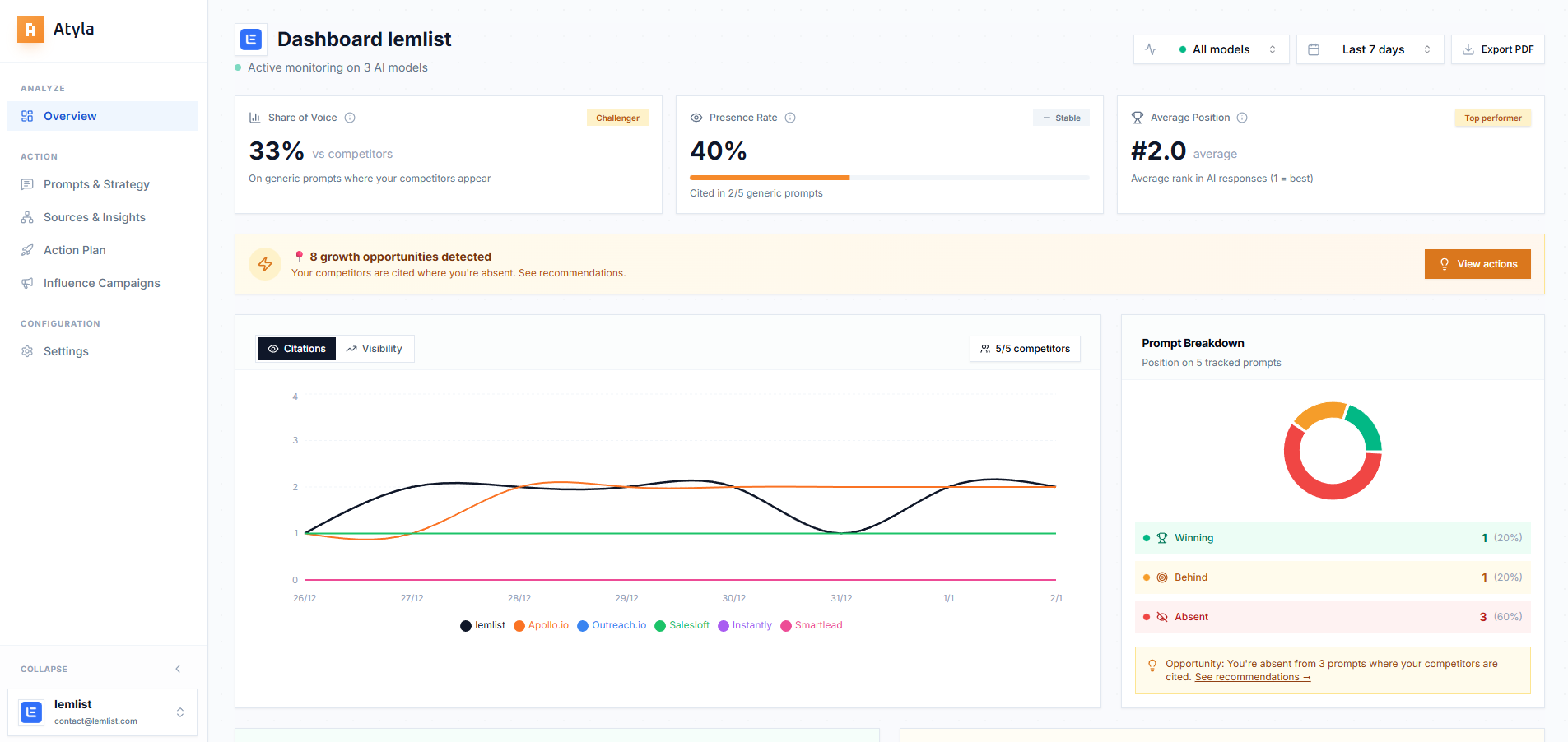
To maximize your results, combine Atyla with our Google Search Console x AI integration to correlate your SEO data with AI visibility.
Profound: The US Enterprise Standard
Positioning: The established leader for large budgets and Fortune 500s.
Profound is a robust suite with a massive index of historical conversations. It is particularly strong for macro trend analysis and understanding Prompt Volumes in the US market.
Pros
- • Massive historical dataset
- • Strong SOC2 & HIPAA compliance
- • Great for "Share of Voice" macro view
- • Professional enterprise interface
Cons
- • Relies on panels/simulations (latency)
- • High entry price ($99-$500/mo)
- • Less granular on technical RAG issues
- • Focus mainly on US market
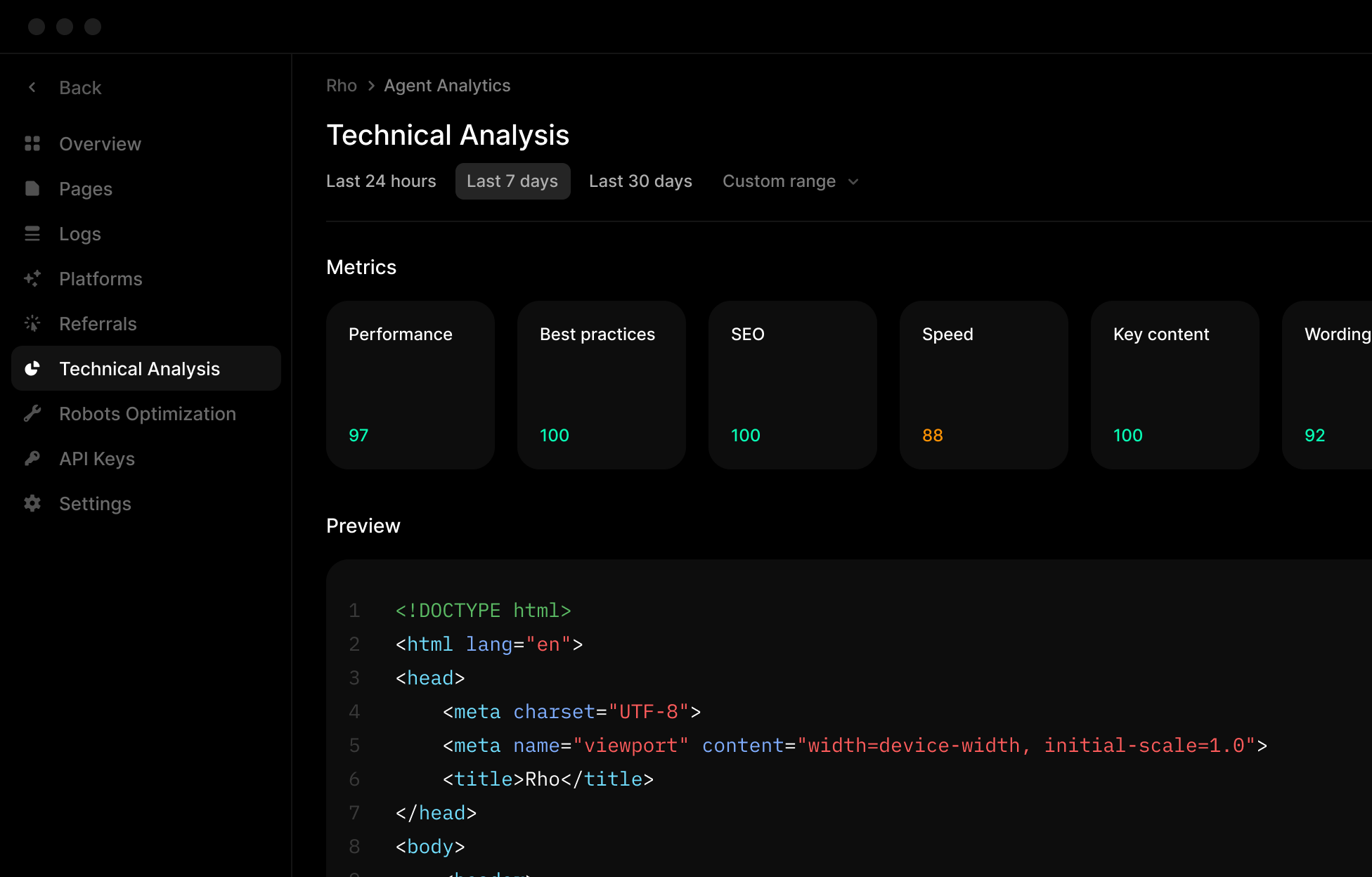
Semrush AIO: The Hybrid Choice
Positioning: The smooth transition for SEO teams.
Semrush needs no introduction. They have started integrating "AI Overview" metrics into their classic dashboards. It's a solid choice if you want to keep everything under one roof, but it lacks the depth of specific LLM citation mechanisms found in dedicated tools.
Pros
- • Complete SEO ecosystem
- • Minimal learning curve
- • Integrated backlink data
- • Automated reports
Cons
- • GEO = secondary feature
- • No real log verification
- • Limited AI model coverage
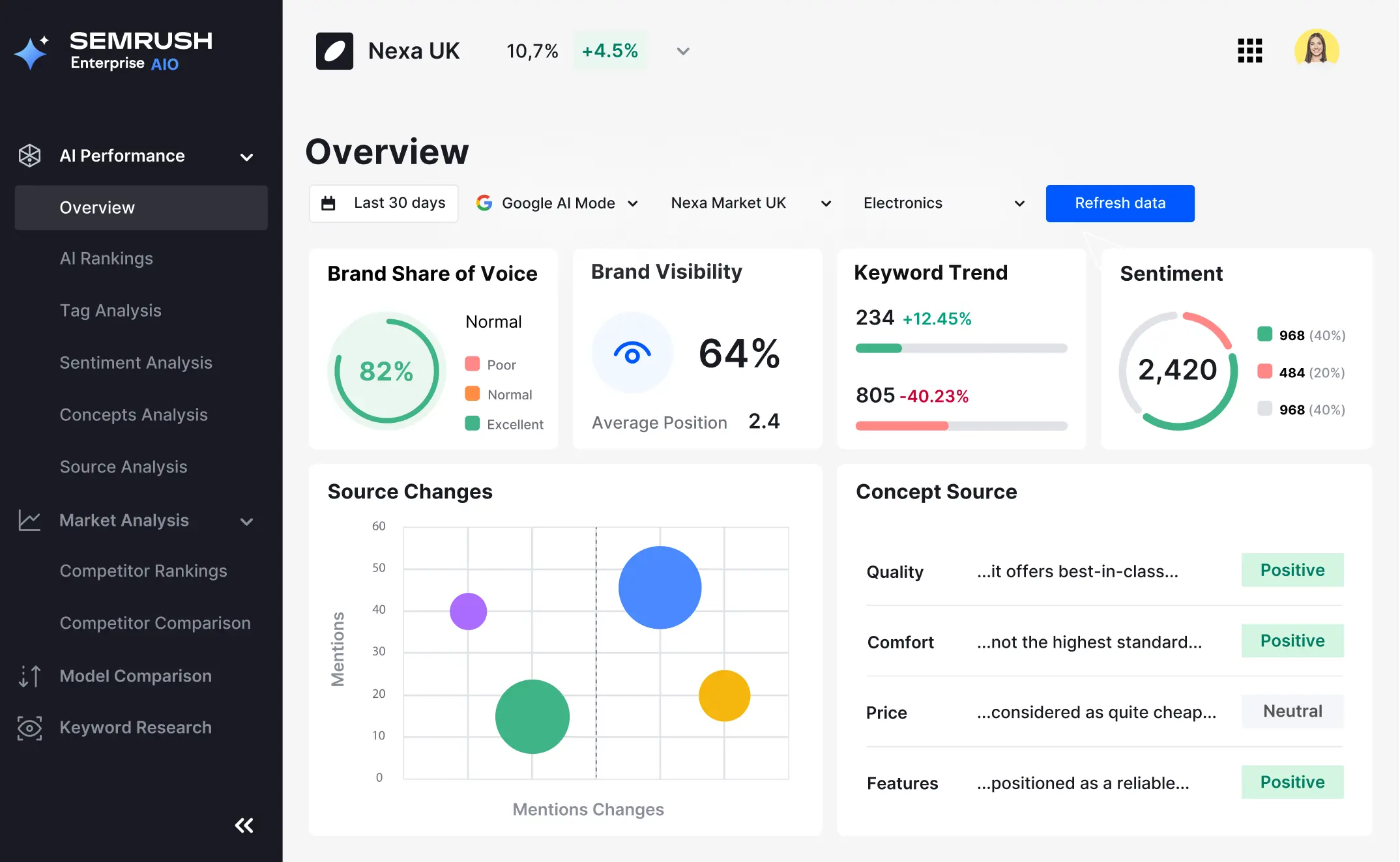
For a deeper analysis of your SEO x AI data, check our guide on how to track AI traffic in Google Analytics 4.
Otterly.AI: The Budget Option
Positioning: Simple and accessible for small teams.
Otterly.AI offers basic brand mention tracking in AI responses. It's a good starting point for teams with a limited budget who want to start monitoring their AI visibility without major investment.
Best for:
- Early-stage startups
- Freelancers and consultants
- Initial AI visibility testing
Manual Verification (Free)
Before investing in a tool, you can manually check your visibility by asking questions directly to ChatGPT, Claude, or Perplexity. It's free but time-consuming and not scalable.
Prompts to test:
- "What are the best tools for [your industry]?"
- "Compare [your brand] vs [competitor]"
- "Recommend a [product type] for [use case]"
6. Buyer's Guide: How to Choose in 2026?
Not all GEO tools are created equal. When evaluating software, ask these three critical questions:
1Simulation vs Reality?
Does the tool just "guess" the answer by running a prompt in the cloud, or does it analyze your server logs to see if the AI actually read your content?
→ Advantage: Atyla (Log Analysis)
2Model Coverage
The market is fragmented. A tool that only tracks ChatGPT is blind to 30% of traffic. Ensure coverage for Claude 3.5 (strong in coding/tech) and Perplexity Pro (factual search).
3Frequency & Freshness
AI answers change daily based on "Temperature" settings. A monthly audit is useless. You need daily or weekly tracking to spot trends.
Our Testing Methodology
To ensure objectivity in this comparison, we applied a rigorous testing protocol over 30 days (January 2026).
Weighted evaluation criteria:
- 1Data Source (40%) — Real server logs vs API simulation vs user panels
- 2AI Model Coverage (25%) — Number of LLMs tracked (GPT, Claude, Gemini, Perplexity, etc.)
- 3Update Latency (20%) — Time between AI crawl and dashboard appearance
- 4Value for Money (15%) — Monthly cost vs feature value
Tools excluded from comparison:
- • Ahrefs — No native GEO functionality (SEO only)
- • Moz Pro — No AI tracking available
- • Brightedge — AIO feature in closed beta
- • Conductor — No response to our demo requests
Checklist: How to Evaluate a GEO Tool
Before subscribing to any tool, verify these 12 critical points:
Data & Accuracy
- Data source documented
- Server logs vs simulation clarified
- Accuracy rate displayed (>90%)
Coverage
- GPT-4o / ChatGPT supported
- Claude 3.5 supported
- Perplexity Pro supported
Features
- Real-time alerts
- API/CSV export
- Competitive analysis
Pricing
- Free trial available
- No forced annual commitment
- Transparent pricing (no opaque "contact us")
Frequently Asked Questions
What is the difference between Atyla and Profound?
Profound focuses on market trend analysis via user panels (Top-down/Simulation approach). Atyla uses server log analysis via Senthor technology to detect which content is actually consumed by AI bots on your site (Bottom-up/Real proof approach).
Does GEO replace SEO in 2026?
No, but it complements it. SEO captures navigational search (clicks), GEO captures conversational information search (answers). Ignoring GEO means losing about 30% of visibility in the B2B market.
How much does a GEO tool cost in 2026?
Prices range from free (manual verification) to over $500/month for enterprise solutions. Atyla offers plans starting at €19/month, Profound starts at $99/month, and Semrush at $129/month.
How to choose the right GEO tool?
Ask yourself three questions: 1) Does the tool use simulations or real data? 2) How many AI models are covered? 3) What is the data update frequency?